Managing air quality and housekeeping in a large industrial facility is rarely a one-size-fits-all situation. When it comes to keeping dust, debris, and fine particulates under control, industrial vacuum systems sit at the center of many operations strategies. But one of the questions facility managers run into early in the selection process is whether to go with a centralized system, a portable unit, or some combination of both.
The honest answer is that the right choice depends on your facility layout, the nature of your work, how your production floor is organized, and how much flexibility you actually need on a day-to-day basis. This guide breaks down the key differences between centralized and portable industrial vacuum systems, the scenarios where each one performs best, and how to think through the decision without overcomplicating it.
Understanding What Each System Is Built to Do
Before comparing the two, it helps to understand what each system is actually designed for.
A centralized vacuum system is a fixed installation. It uses a single, high-capacity power unit located in a mechanical room or utility area. From there, a network of piping runs throughout the facility. Workers connect hoses and tools to inlet valves at various stations along the pipe runs to vacuum up material wherever it is needed.
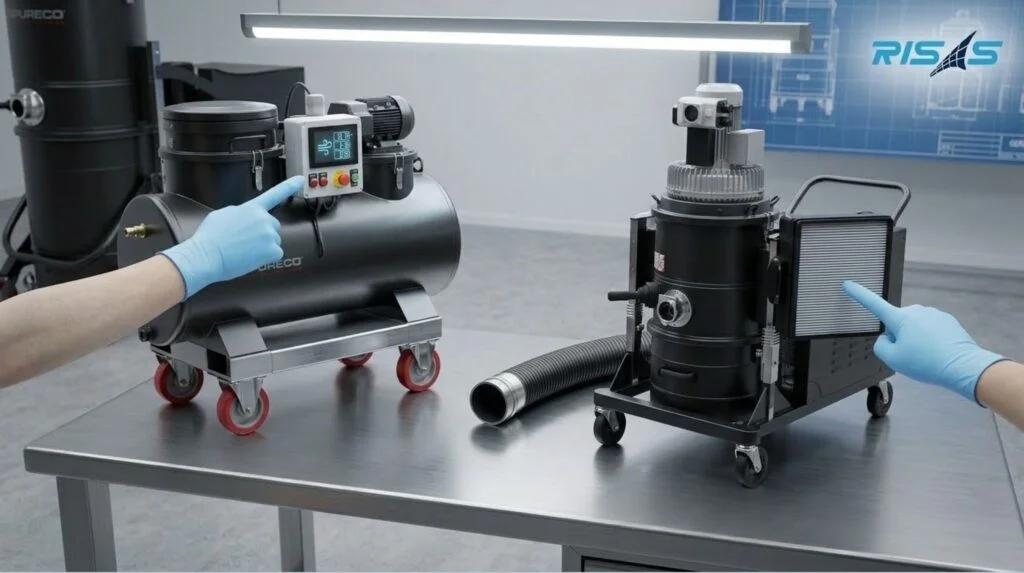
A portable industrial vacuum is a self-contained unit that can be moved from one location to another. These range from single-phase electric units suited for lighter-duty tasks to heavy-duty, continuous-duty machines built for demanding industrial environments. Operators wheel them to the work area, plug them in, and get to work.
Both systems can be equipped with a range of filter types, including HEPA filtration for facilities dealing with fine or potentially hazardous particulates. The differences come down to where they work best.
The Case for Centralized Vacuum Systems
If your facility is large and your vacuuming needs are consistent and spread across a wide footprint, a centralized system often delivers the best return over time.
Coverage without the clutter. One of the biggest advantages of a centralized system is that it eliminates the need to haul equipment across the floor. Inlet valves are built into the piping infrastructure at regular intervals, which means workers connect a hose and go. There are no power cords to trip over, no units to maneuver around machinery, and no downtime spent searching for the right equipment.
Consistent suction across the facility. Centralized systems are designed to maintain steady airflow across all active inlets. When properly designed, they deliver reliable performance regardless of where on the floor the work is happening.
Lower long-term operating costs. A single high-efficiency motor running continuously is typically more energy-efficient than operating multiple portable units. Over the life of the system, that difference adds up, especially in facilities running multiple shifts.
Reduced noise at the workstation. Because the main power unit sits away from the production floor, centralized systems are noticeably quieter at the point of use. In environments where workers spend long hours near their stations, this matters more than it might seem.
Easier to maintain in one place. Rather than tracking down and maintaining multiple units scattered across the facility, maintenance teams work with a single power unit and a fixed pipe network. Filter changes and service intervals are more predictable and easier to schedule.
That said, centralized systems come with some real considerations. The upfront installation cost is higher. The pipe network has to be designed carefully and installed correctly. If your facility layout changes frequently due to shifting production lines or equipment moves, the fixed piping can become a liability. And if the power unit goes down, it affects the whole system until repairs are complete.
The Case for Portable Industrial Vacuum Systems
Portable vacuums fill a different role, and in many facilities, they are not just a backup option. They are the right primary solution.
Flexibility where it counts. Portable units go where the work is. In facilities where production layouts shift, where maintenance tasks happen in unpredictable locations, or where cleanup needs are sporadic and spread out, portables are the more practical choice. You are not limited by where the piping ends.
Lower upfront investment. Portable systems do not require infrastructure installation. You purchase the units, and they are ready to deploy. For facilities with limited capital budgets or those in the process of expanding, this is a meaningful advantage.
Ideal for spot cleaning and spill response. Even facilities that use centralized systems often keep portable units on hand for situations where a quick response matters. A spill near machinery, a sudden maintenance need, or a cleanup task in a remote corner of the building is much easier to handle with a unit you can roll over in minutes.
Multiple units, multiple tasks. Portables let you run several cleanup operations simultaneously without being dependent on a single power source. If one unit needs service, the others keep running.
Good fit for smaller or mid-size operations. If your facility does not have the square footage or production volume to justify centralized infrastructure, portables give you serious industrial-grade performance without the overhead.
The trade-offs with portables center on consistency and scale. In a very large facility, managing, charging, servicing, and storing multiple units takes organizational effort. Units can go missing, filters can get neglected, and performance can vary across the fleet if maintenance is not disciplined.
Key Questions to Ask Before You Decide
Walking through a few practical questions can help clarify which direction makes the most sense for your specific situation.
How large is your facility, and how spread out are your vacuuming needs? Facilities over 50,000 square feet with consistent, high-volume vacuuming across the floor are generally strong candidates for centralized systems. Smaller facilities, or those with concentrated work areas, often get better value from portables.
How stable is your floor layout? If your production lines move regularly, or if your facility is still growing and changing, the flexibility of a portable system is worth serious consideration. A centralized system needs a layout that is reasonably fixed to deliver its full benefit.
What materials are you picking up? Heavier debris, metal chips, and abrasive materials put different demands on equipment than fine dust or powder. The material type influences which vacuum design holds up best over time and which filtration approach keeps your workers and machinery protected.
What are your filtration requirements? If your facility handles silica dust, certain metal particulates, or other fine materials with exposure limits regulated by OSHA, filtration is a non-negotiable conversation. Centralized systems and high-quality portables can both be configured with HEPA filtration, but you need to confirm that any system you choose meets the requirements for what you are actually capturing.
What does your maintenance team look like? A centralized system rewards a proactive, organized maintenance program. If your team is stretched thin, the simplicity of managing portable units with straightforward maintenance intervals might be a better operational fit.
When the Best Answer Is Both
It is worth pointing out that a large number of facilities end up running a hybrid approach, and that is not a compromise. It is often the smartest strategy.
A centralized system can cover the high-traffic, high-volume areas of the facility where consistent cleanup is critical. Portable units handle edge cases, maintenance tasks, and areas where running piping is not practical. The two systems complement each other, and together they cover gaps that neither would handle as well alone.
Getting the Sizing Right the First Time
One of the most common and costly mistakes in this category is specifying a system that is either too small to keep up with production or too large to justify operationally. In centralized systems, this usually shows up as inadequate suction at the farthest inlet valves. In portable fleets, it looks like units running constantly without ever quite keeping pace.
Getting the right system means accounting for the number of simultaneous users, the total pipe run length and inlet count, the materials being captured, and the filter maintenance burden those materials create. These are not guesses. They are calculations and assessments that experienced providers can walk you through before you commit to anything.
Final Thoughts
Choosing between centralized and portable industrial vacuum systems for a large facility comes down to layout, budget, flexibility needs, and the nature of the work happening on your floor. Neither option is universally better. The right answer is the one that fits how your facility actually operates, not just how it looks on a blueprint.
If you are unsure which direction makes sense, start by documenting where and how often vacuuming happens in your facility. That usage map will tell you more about what you actually need than any product spec sheet. From there, working with a knowledgeable distributor who can assess your specific conditions and recommend a properly sized solution will save you from expensive mistakes down the road.